


Illustrator Sydney Smith
I was so captivated by Sydney Smith's unique style, I had to try it. Its so fun making stencils and spattering paint. Maybe you should try it too? Watch: How Illustrator Sydney Smith uses his own stencils to paint beautiful kids' books:

Illustration Challenge #29
Change up your tools. This is your week to try something new - pastel, paints, crayons, charcoal - it doesn't matter. Be sure to get some nice big paper so that you go big with the new feel. It doesn't matter if you're terrible. It will be a new thing - what would you expect, to master it in the first try? The point is to allow yourself to have fun and mess up!
Merry Christmas from Scotland!
I hope you and your loved ones have a wonderful holiday and new year filled with good things.

Vivian French's THE MOST WONDERFUL THING IN THE WORLD

Here at the University of Edinburgh College of Art, I have the distinct pleasure of being mentored by Vivian French. Vivian is the award-winning author of over 270 children’s book titles including her latest picture book, THE MOST WONDERFUL THING IN THE WORLD, illustrated by Angela Barrett (Candlewick Press). Here’s the blurb:
Once upon a time, a king and a queen promise to marry their daughter to the young man who can show them the most wonderful thing in the world. Suitors arrive at the palace, one after the other, with elaborate gifts of jewels, inventions, and even mythical beasts, but nothing feels quite right to the overwhelmed majesties. It is only when a shy young man, who isn’t a suitor at all, steps forward that the king and queen finally understand what the most wonderful thing in the world actually is. Vivian French’s touching fairy tale is made all the more enchanting by the many subtle surprises included in Angela Barrett’s exquisite illustrations.Since I have such lovely access to Vivian, I wanted to ask her some questions to share with all of you…
Vivian, how did the idea for THE MOST WONDERFUL THING IN THE WORLD come to you?
The story of TMWT is based on a traditional story that Angela Barrett loved as a child. She brought it into Walker Books and we had a look at it together - and I thought I could develop it, and have fun with it. In the original the King and queen are besieged by suitors, but there's not much mention of what they bring; Angela thought this would give her a lot of scope for inventive illustration, and I loved the idea of changing the story so that it had a new life. There's a lot about gardens in the original; I preferred the idea of Lucia and Salvatore exploring the city together, and gradually falling in love without knowing too much about each other.

It was much too long to begin with. I had to do a good deal of slicing and cutting, especially once Angela's amazing pictures starting arriving. I had to change the text to fit; she often drew something entirely different from the gifts that I'd described. Also the design required the text to be shaped on certain pages so it didn't argue with the curves of the illustration; I spent a lot of time counting letters and spaces!
In our workshop, you talk about coming up with a beginning and an ending first, before coming up with the middle of a story. Can you talk about that a little?
I like to have a clear idea in my head about where the story is going to go ... rather like knowing which country you're going to end up in when you travel. (Even though you don't know the exact location.) I also think it's important to know what emotions are going to be called upon - both in the characters, and in the reader.

I'm not sure what this question means. Stories unravel in my head ... I'm never aware of chasing them down.
What was your writing journey like when you were starting out? How did you sell your first book?
A friend who was a published children's author told me to try and write ... I'd been a story teller and an actor (children's theatre) for a long time. She sent my first attempts to her publisher and they said no, but Walker Books were in the same building, and they said yes. Something of a surprise, as I'd never really considered writing children's books. I'd written plays, though.
You’ve been working with me on creating “Heart Illustrations.” Can you explain what that means?
I think I was trying to explain the need to touch in to deep emotions. The characters in a story have to speak to the heart of the reader, to connect, to make them feel something they didn't feel when they looked at the first page - and the emotions have to feel true and not contrived or forced. A book is a journey that the characters and the reader take together. Some books, of course, are little more than a visual joke (and very funny they are too! I wouldn't be without them) but I'm talking about the books that children look at/read over and over again because there's an essential truth within them.

Lucy Juckes and I felt there was an uncomfortable void between leaving art college and going out into the world; we wanted to help prepare emerging talent so they could feel confident of their work, their portfolio, and know something about what was on offer. We arrange for five illustrators (not necessarily straight out of college; some have been around a little longer, but for various reasons need support and a refresh) to be mentored for a year by five professional illustrators with substantial experience. We're very careful how we put the mentor/mentee together; it has to be a mutually comfortable fit. And, at the end of the year, there's an exhibition in the National Gallery of Scotland - lucky us! Last time we had over 90,000 visitors. We're hoping to do even better this time ... the exhibition is on until the end of February.
There's lots more information on www.picturehooks.org.uk. We're incredibly fortunate to have the support of the illustration department at ECA, and the National Gallery of Scotland. And, of course, Creative Scotland.
What are you working on now?
A short novel for junior readers, a couple of early readers, a non-fiction story or two ... and there's a play that is REALLY late on delivery dates!
I asked Vivian to share a photo of her fave writing spot and she said...
It's the train. Any train. Or a long haul flight ...

Collograph printing at ECA
I told you about this label project I assigned myself. I needed three labels, one for my Almanac (a.k.a. Diary), for which I used linocut on the rubber carving substrate (which I hated). I'm not sure I showed it to you finished, so here it is.

You've probably done collograph before... In kindergarten, you may have glued macaroni to a piece of cardboard, lacquered it, then put paint all over it, and done a relief print with paper. It's a fun thing to do. But this method is a little more, *ahem*, grown up.
First I created my plate using Evo board. I cut out the word "Tricksters" (the name of my 'big' project). I traced it onto the board and cut off the top layer of paper. Then I took the cut out paper version and glued it above. Then I lacquered the front and back to seal it up. Sounds complicated, but it will make sense in a second...


You've probably done collograph before... In kindergarten, you may have glued macaroni to a piece of cardboard, lacquered it, then put paint all over it, and done a relief print with paper. It's a fun thing to do. But this method is a little more, *ahem*, grown up.
First I created my plate using Evo board. I cut out the word "Tricksters" (the name of my 'big' project). I traced it onto the board and cut off the top layer of paper. Then I took the cut out paper version and glued it above. Then I lacquered the front and back to seal it up. Sounds complicated, but it will make sense in a second...
Coloring Page Tuesday - Christmas Tree Dude
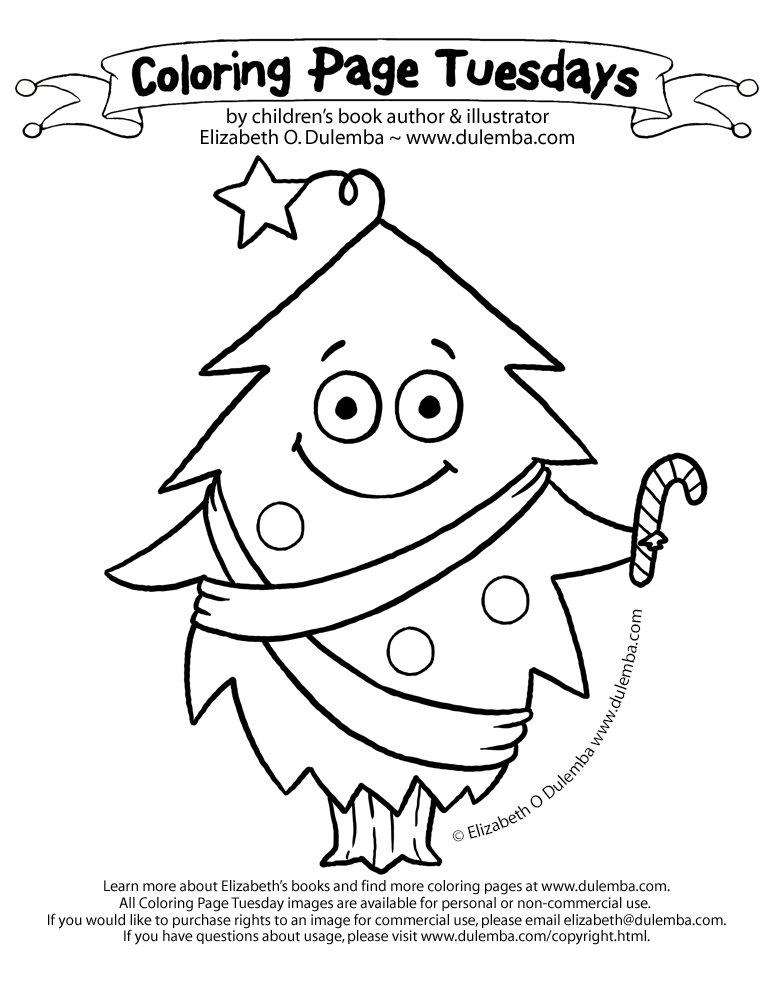
CLICK HERE to sign up to receive alerts when a new coloring page is posted each week and... Please check out my books! Especially...
 THE 12 DAYS OF CHRISTMAS IN GEORGIA! Makes a GREAT teacher gift!
 Don't live in Georgia? Check with your local bookseller - Sterling has a version for each state. Click the cover to learn more.
I create my coloring pages for teachers, librarians, booksellers, and parents to enjoy for free with their children, but you can also purchase rights to an image for commercial use, please contact me. If you have questions about usage, please visit my Angel Policy page.
Wood block letterpress at ECA
I told you about learning letterpress the other day - well, that was the metal letters. We also learned how to use the wood block letters, which are like working with marvelous antiques. Truly, many of them are hundreds of years old. Printing them reveals wood grains, nicks and scratches. They are organic and beautiful! They're also a little easier than the metal letters. Steve quickly put together some wooden letters directly onto the Eagle press.

Just like in the relief printing I did for my linocut project, we inked the blocks, placed paper on top, pulled the arm of the ancient press, and came up with this.
One of the projects I assigned myself was to create handmade labels for all my almanac books and boxes, using a different method for every one. So, the next day, I went back down to the print lab and created the label for my Almanac box.
First I selected the gorgeous wood block letters (there were no lower case e's), then placed them on the press the way Steve had. Aren't they gorgeous?

Then I did it again onto my caramel paper, which has become a color theme for these books. The paper was thicker, so I had to use a piece of felt to increase the tension. It turned out great.
Just like in the relief printing I did for my linocut project, we inked the blocks, placed paper on top, pulled the arm of the ancient press, and came up with this.
One of the projects I assigned myself was to create handmade labels for all my almanac books and boxes, using a different method for every one. So, the next day, I went back down to the print lab and created the label for my Almanac box.
First I selected the gorgeous wood block letters (there were no lower case e's), then placed them on the press the way Steve had. Aren't they gorgeous?
Then I did it again onto my caramel paper, which has become a color theme for these books. The paper was thicker, so I had to use a piece of felt to increase the tension. It turned out great.
John Dowland
I've been listening to a lot of baroque lute and classical music lately because I've found it blocks out the sound of conversations around me at school, and I can actually still concentrate with it playing. It also happens to have a lovely Christmas sound. Want to hear more? Click here!

Illustration Challenge #28
Christmas is just around the corner. Draw a tree and decorate it with all the things that mean the most to you!!!
Weird Christmas things...
Edinburgh is GORGEOUS for Christmas! But every now and then I see things that make me wonder... Like this lit up cow, sitting above a restaurant on Prince's Street. (Okay, okay, so I think it's a steak place.)


Friday Linky List - 18 December 2015
 At Ancient-Origins.net: Meet Father Frost and his Fairy Goddaughter Snow Maiden: Magical Characters of Winter from Russia - Postcard of Ded Moroz by Matorin Nikolay Vasilyevich from 1917. (Public Domain)
From The New York Times: Choose to Be Grateful. It Will Make You Happier.
At Food52 - Cookies of the World!!! SO GREAT!
At Milk & Bookies - Author Champion: Rana DiOrio (my publisher at Little Pickle Press - she talks about LPP books including A BIRD ON WATER STREET)
From GREAT!storybook: Top 20 Children's Book Agents 2015, based on sales
From PW (via SCBWI Belgium): Children's Publishing in China: Highlights from the First GKC China Deep Dive
In my search for Heart Illustrations, I love this post at Picture Book Builders: Marianne Dubuc's THE LION AND THE BIRD
At Bookshelf: Is there still any point collecting books? with a lovely quote by Howard Jacobson
Daniel Kirk's - 'Twas the Night Before Christmas - Guest Post

On Creating 'Twas the Night Before Christmas
by Daniel Kirk
It must have been twenty years ago that I first came up with the notion of a woodsman-Santa, wearing plaid coat and a cap with earflaps. I did an oil on canvas painting of him, standing with a camping lantern on a dark, snowy night, and made it into the holiday card that I used to send to friends and family. One of my editors, Howard Reeves, suggested that I should write a story about my character. Over the decades I’ve tried a couple of times to tell the story of this Santa, but I never came up with the perfect idea.

My favorite version happens to be the one Anita Lobel illustrated in 1984, featuring Brooklyn as the backdrop to the familiar tale. Gyo Fujukowa’s version is also quite lovely and stylized, as is Leonard Weisgard’s classic. I’d have to say that I tend to like the versions that add something new or different to the old poem. If something is worth doing, I believe it’s important to put your own stamp on it! It seems to me that it’s an illustrator’s job to make text come alive in a distinctive, individual way.


 I’ve experimented with a lot of different media over the years. I began my children’s book career making oil paintings on canvas, then went to gouache, pastel, colored pencil, collage and many other things! My last five or six books have begun with pen and ink drawings, which I scan into my computer and add color and textures in Photoshop. It’s fun for me as an illustrator to try new techniques. As they say, if you always hit the target, you’re standing too close, and I like to challenge myself if I can.
I have a painting studio in the barn/garage out at the end of our property. But these days I find that it’s nice to set up the computer in the dining room in the house and work there, where the natural light is plentiful, and I am always close to the kitchen. I work better if I always have snacks on hand! And as we enter this holiday season, I am tempted to bake some Christmas cookies to nibble on while working on my next book project.
Learn more about Daniel at http://danielkirk.com.
Twas the Night Before Christmas by Clement Moore and illustrated by Daniel Kirk, published by Abrams Books for Young Readers (£10.99) CLICK HERE to purchase the book directly from Abrams.
Christmas in Edinburgh!
It gets dark pretty early in Scotland - it's pitch black by 4:00pm. To counter that, Edinburgh lights the town back up for Christmas! There are TWO Christmas villages within walking distance from our flat. The first one hosts a double decker carousel.


The other Christmas village is down on Princes Street. Stan and I visited that one during the daytime. It also has an ice-skating rink and tons of stands where you can buy gifties of all kinds... or more mulled wine.


The other Christmas village is down on Princes Street. Stan and I visited that one during the daytime. It also has an ice-skating rink and tons of stands where you can buy gifties of all kinds... or more mulled wine.
Subscribe to:
Posts (Atom)