Eliza Wheeler on Method

I am a huge fan of Eliza Wheeler's work, so am absolutely thrilled she was able to spare some time from her very busy schedule to stop by and share her creative process with us today. Happy reading!

Eliza Wheeler on Method

     I have illustrations in two books that came out in August; the first is a picture book by Varsha Bajaj, THIS IS OUR BABY, BORN TODAY, and the second is a middle-grade novel by Kate Milford, THE LEFT-HANDED FATE.
     These two books couldn’t be more different! THIS IS OUR BABY, BORN TODAY is a bright, sweet book celebrating the first day in the life of a baby elephant, with all the jungle family and friends welcoming him into the world. THE LEFT-HANDED FATE is a nautical adventure set during the war of 1812, when three teenagers land on a mysterious island city to search for pieces to a weapon that could change the fate of the world.
      Since I started illustrating full time, about half the books that I illustrate are picture-books, the other half are middle-grade novels. It’s a great balance of work that’s bright and sweet, and dark and more mature. I’ve experienced distinct differences illustrating for both formats that I’d love to share with fans of the children’s book genre. For simplicity’s sake, my examples are traditionally formatted middle-grade novels and picture books. But, it’s worth mentioning that there have been a growing number of highly-illustrated middle grade novels and chapter books these days (for example, THE INVENTION OF HUGO CABRET and other Brian Selznick novels), which is exciting for both illustrators and kids resistant to books without pictures (which I is how I was as a kid).

FORMAT
Picture Books: Typically consist of 32 full color pages, with every spread of the book covered in artwork. The text and artwork share page space. The size of the book is often somewhere around 9”x11” (closed), which means that the physical paintings are larger in size. (I work at 100% to the print size.)
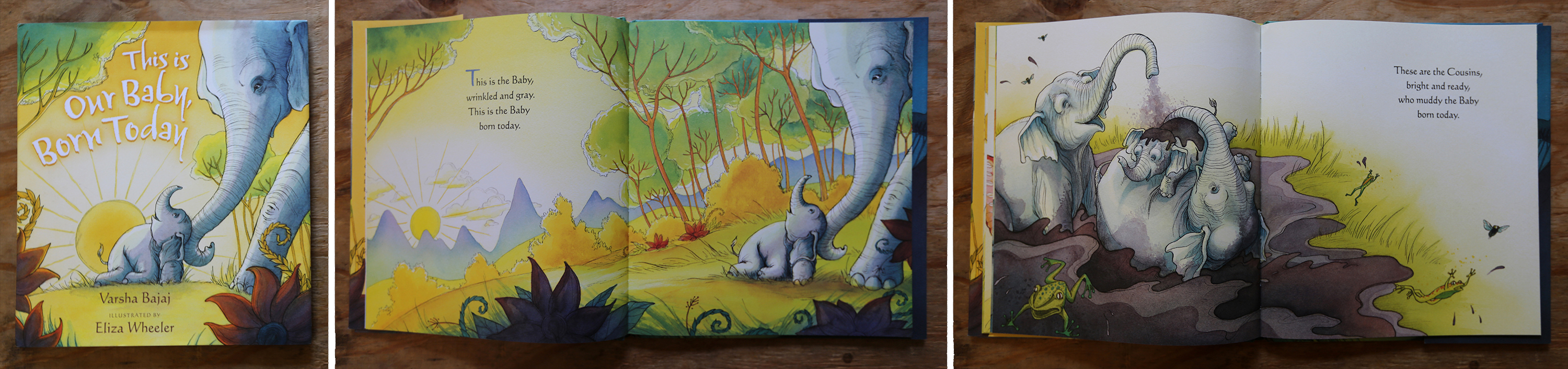
Click the image to see a larger version in a new window.

Middle Grades: Vary in length, but are usually a hundred to several hundred pages long. Occasional illustrations supplement the text throughout (typically one image per chapter; sometimes less, sometimes more). The book size also varies, but they are often around 5.5”x8” (closed), and the illustrations are a mix of black and white full page and spot illustrations laid out separately from the text. For THE LEFT-HANDED FATE, I also created a few illustrations that cover an entire wordless spread. The physical paintings are much smaller than picture book artwork.

VISUAL FUNCTION and FLOW
Picture Books: The words and pictures play their own equally important roles in telling the story. The visuals flow from page to page, and need to have rhythm, cohesion in characters and colors, and variety in compositions. The way that the pages are strung together is as important as creating singular successful images. I begin every picture book by working first on storyboards to get a sense of how all these elements are flowing together. In THIS IS OUR BABY, BORN TODAY, the book begins in the morning and ends at night, so I used these storyboards to plan how the colors would flow as well.
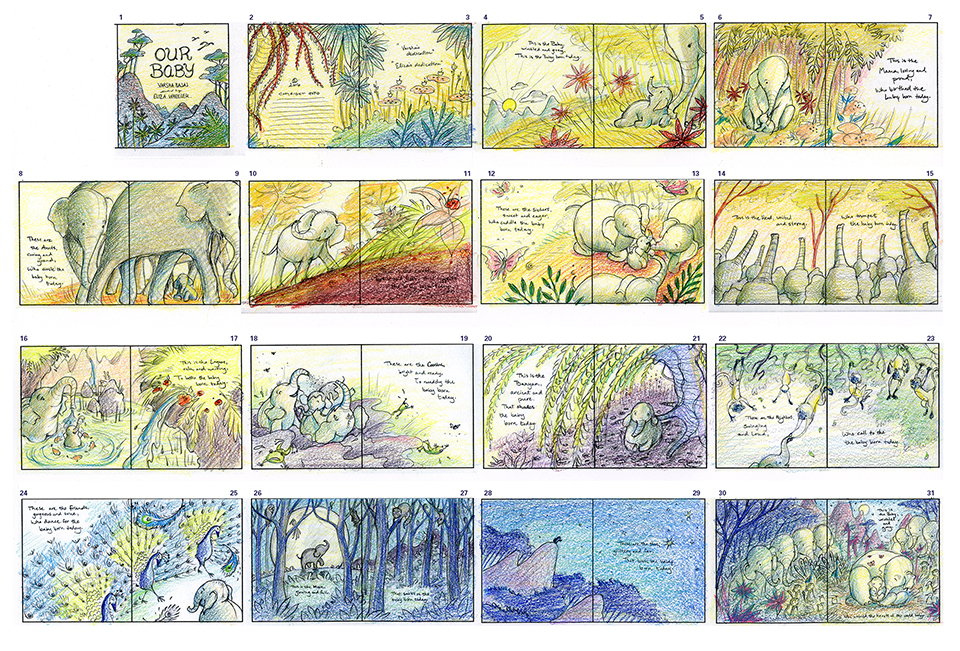
Click the image to see a larger version in a new window.

Middle Grades: The words are the main vehicle for the story, while the images work as stand-alone scenes sprinkled throughout the text. They’re less about telling the story, and more about giving little windows into the world the author has described. While the images’ relationships to each other are not as important, what is important is that they correctly correspond with the scenes in the text.
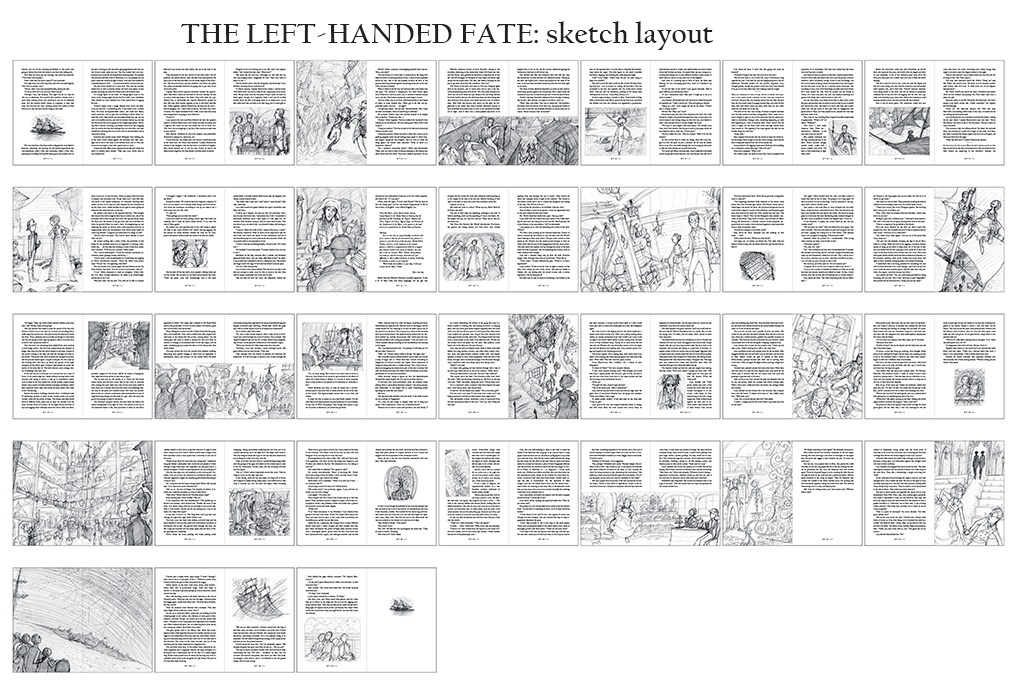
Click the image to see a larger version in a new window.

CONTENT
Picture Books: The child audience is usually ages 3-7, and so the child characters in the book should be somewhere around that age, too. Picture books have another important audience—the adult who’s reading the book aloud to the child. When I create the artwork, I’m hoping that it will appeal in some way to both of these audiences. Generally, picture book artwork is sweet, colorful, and playful.

Middle Grades: The audience here is generally in the 8-12 year-old range, so the characters in the book are often in that age range as well. I’ve had to study visual differences between kids that are 5, 8, and 12. I seem to naturally draw 5 year-olds and 80 year-olds. Anything in between takes some work! As with the writing style and topics of middle-grades, the artwork is often darker and more mature.

SCHEDULE and PAY
     Picture Books: Have longer schedules; I typically need a year for sketches, revisions, and final artwork. The art deadline is 1 year from the publication date, so if a book is going to be published in the spring, the artwork is due the previous spring. As for pay, advances for picture books are higher than middle grades, and as the illustrator, the royalty earnings are split equally with the author (generally 5% for each).

Middle Grades: The sketching process can stretch out over months (or years) due to the editorial process between the writer and editor, and I find with novels there’s a lot more “hurry up and wait” time involved. Once the sketches are approved, the time to create the final artwork is much shorter than for picture books, usually a couple months, and it happens closer to the publication date. The pay for middle grade artwork is lower than picture book work as well, and for books with minimal illustrations it’s rare to get royalties for the work. For the novels like THE LEFT-HANDED FATE, with a high quantity of drawings, the illustrator usually gets a small royalty.
Click the image to see a larger version in a new window.

WORKING PROCESS
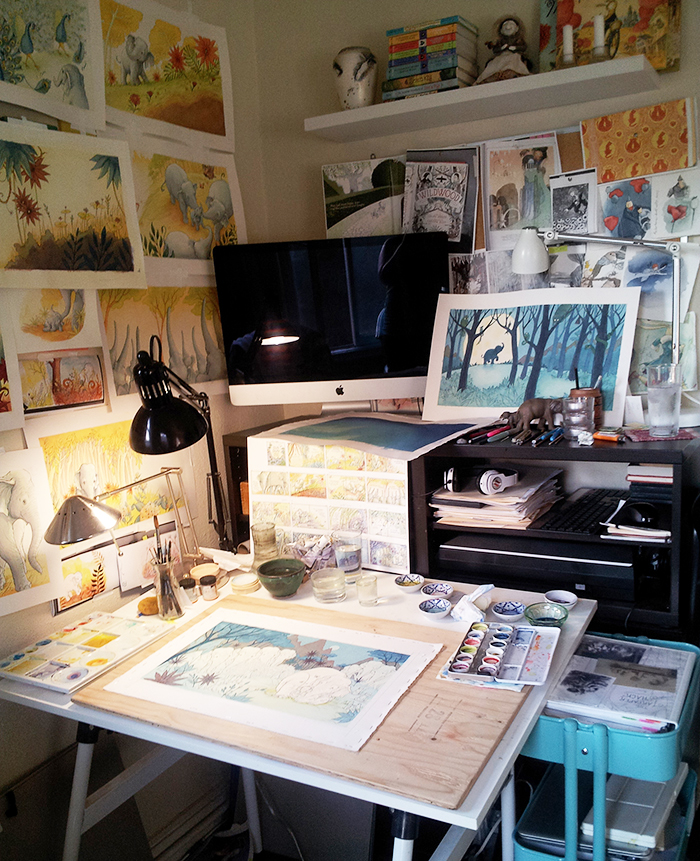
      The difference between working on large full-color paintings and smaller grayscale paintings is a big one. With grayscale painting, the biggest focus is on tone and contrast. With full-color art, there are so many more decisions to be made about color palette, saturation, brightness, contrast, etc. As a result, I find working on a picture book to be a more immersive, all-consuming process. I try to keep my schedule completely free of other work during the last months on picture book final artwork, and often I’m exhausted, physically and creatively, when finished. Since middle grade books are less labor intensive, the work is often refreshing coming after months on picture book art. That said, the immersive quality of a picture book is thrilling, and creates an emotional bond with the world and characters that’s intrinsically rewarding.
      I love creating bright, sweet artwork for very young readers, and dark, magical art for older audiences. The differences in these formats are what make them a perfect balance of projects for me.
      Thanks so much to Elizabeth for inviting me to share about this work with everyone!

Thank YOU Eliza! - e

The Edinburgh International Book Festival - Part 2

Is now over. Happily, I took advantage of a good bit of it. I told you about the SCBWI events the first week here. For the second week I attended three events. The first was Vivian French's discussion on The Hook of Visual Literacy.
Per the website, "Author and Picture Hooks founder Vivian French discusses how the format can be adapted for classroom use, and the resources available to develop visual communication in children. She is joined by Aurelie Norman from Wardie Primary, Edinburgh, who has worked with Picture Hooks." (Picture Hooks co-founder Lucy Juckes is to the left.) The good works Vivian is doing for illustrators and students here in the UK is truly remarkable. She's changing lives, and I'm so proud to call her a friend and mentor.
     The next event I attended was a panel of illustrators.
Emily Gravett, Alex T. Smith, and Lydia Monks talked about their careers, breaking in, their methods, and their projects. It was moderated by the chair for the Kate Greenaway Award, Joy Court, and was truly enlightening. These are all award-winning illustrators at the top of their field here in the UK.
The third event I attended was Judith Kerr, author of the Mog series and The Tiger Who Came to Tea, which is a classic here in the UK like Goodnight Moon or Where the Wild Things Are are in the US.
She's 93-years-old and a beloved treasure. The theatre was packed! She also happened to be very funny and entertaining.
     What I've found so interesting about the book festival this year is how different the UK market is from the US market. Yes, there is crossover, but the UK is definitely its own sandbox. In fact, I'll be doing my dissertation this fall (in the US it would be called a thesis) on the topic: "Comparing and contrasting the Randolph Caldecott and Kate Greenaway Award winners to identify trends, similarities and differences between the US and UK picture book markets." The book festival was a wonderful addition to my research! There was also this - a twig-woven sculpture of the BFG.

Coloring Page Tuesday - Fairy Orb

     Wow again - you guys are really enjoying these crosshatch pieces! I'll give you one more... I captured this one for you before I started the cross hatching. Click the image to access a line art version for coloring. And please send your completed versions to me (as low resolution JPGs). I'd love to see what you do with her!
     CLICK HERE for more coloring pages!
     CLICK HERE to sign up to receive alerts when a new coloring page is posted each week and... Please check out my books! Especially...
my debut novel, A BIRD ON WATER STREET - winner of six literary awards. Click the cover to learn more!
     When the birds return to Water Street, will anyone be left to hear them sing? A miner's strike allows green and growing things to return to the Red Hills, but that same strike may force residents to seek new homes and livelihoods elsewhere. Follow the story of Jack Hicks as he struggles to hold onto everything he loves most.
     I create my coloring pages for teachers, librarians, booksellers, and parents to enjoy for free with their children, but you can also purchase rights to an image for commercial use, please contact me. If you have questions about usage, please visit my Angel Policy page.

SCBWI British Isles - 20-year Celebration!

SCBWI British Isles is 20-years-old! To celebrate, our Southeast Scotland division had a picnic in the Princes Street Garden just below the statue of Wojtek the Bear.

Elizabeth Wein's basket.
Karen Harding and I were the first ones to arrive - here we are with the castle in the background.
We set out my blanket and it quickly expanded with fellow SCBWIers and more blankets all around. And the weather, which was supposed to be a little dicey, was perfect.
Something nice happened this day. It was the first time I participated in an SCBWI even where I really felt like I was getting to know people - where I was surrounded by (albeit new) friends.
SUCH a nice feeling. We all talked about books and art. Three of the six illustrators in the group found each other. That's Jeanne Dron, me, and Hannah Sanguinetti.
We made plans for a future get-together at Waterstones. Our Network Organiser (alongside Louise Kelly), Sheila Averbuch was thrilled with that and the high attendance to report back to the main British Isles folks. (She's on the left and that's Elizabeth Wein on the right of Code Name Verity fame.)
I thought I'd have time to kill before the panel I was attending at the Book Festival. But no - we all chatted for hours! (See me in there towards the right?)
Truly, that's what SCBWI is all about - finding your peeps, a place to feel at home, your tribe. I love that I can find that anywhere in the world!

VIDEO: Pharrel Williams is Inspiring Again!

I love this surprise visit of Pharrel Williams to student at his former music school. It's especially interesting from 18:13 onward - and quite pertinent to writers too. Click the image to watch on YouTube:

Dazzle Ships Poetry Reading

Jane Yolen came in town the other day to participate in a reading of poems about Dazzle Ships. I mentioned Dazzle Ships in another blog post...
     Ships were painted like this during WWI (maybe also during WWII) to throw off locators trying to figure out which direction or how fast ships were going. This one was recently commissioned by artist Ciara Phillips for the Edinburgh Arts Festival, as was the poetry reading about Dazzle Ships hosted by Marjorie Lotfi Gill of Open Book at the Edinburgh Bookshop.
     Two wonderful things together, Jane and the Edinburgh Bookshop, we were so there! (And Jane got us guest tickets - yay!) Here was the program, a limited edition risograph printing by Out of the Blueprint:
The poems took on several different angles and moods. I especially liked the one about the women who painted the ships (yes, they were all women), who were able to get out of the house and wear trousers for the first time! Jane's poem was also wonderful, of course.
     Factoid: Did you know that she shares a poem every day via email? You can sign up HERE.
      What a fun evening!

Dalriada Sunday Music Jam

So I told you about that piano on the beach? It foreshadowed the music we were about to stumble into... Up the boardwalk from our picnic is a pub in a grand old house called Dalriada.
We hadn't been yet, so today was the day. We popped in for some tea and stumbled across the Sunday ritual there.
Two tables near the window said 'reserved for band' so we got the next free table over. Silly us, the band quickly grew around us on all sides.
Turns out Sunday is jam session day for whoever wants to join in. We were in the way. But the only free seats left in the place were at an occupied table. Stan asked if we could join them. They said yes. Turned out to be the sister of the main guitarist. She and her husband were visiting from Manchester.
We had a nice conversation about the music. A few of the musicians are regulars. Many play in other bands and get pretty regular work at caleighs, enough that they don't really advertise themselves, which is why I sadly can't share a website.
     I can, however, share the short video I made when they broke into an especially fun Scottish tune. Click the image to listen on Youtube.
Ironically, the fiddle player in the video, Jo, showed up at a poetry reading we attended the next evening. (More on that soon.)
     I tell you, it's so easy to make friends here, and most of the friendships begin with the phrase, "I was in a pub..."

Friday Linky List - 26 August 2016

From Nightlight: How Did Children's Literature Evolve From Prim Morality Tales to the Likes of Captain Underpants?

From Muddy Colors: 2016 Sketchbook Preview: The Gryphon Hunters and Other Adventures by Justin Gerard and Fairy Tales and Folklore by Annie Stegg Gerard

From K.D. Rausin (via Emma Dryden): The Importance of Getting Up and Trying Again

From The City of Lost Books: W.W. Tarn, The Treasure of the Isle of Mist

From The Sydney Morning Herald: The Children's Book Council of Australia's Book of the Year Awards: the winners your kids must read

From Brain Pickings: Neil Gaiman on Why We Read and What Books Do for the Human Experience

From The Scottish Book Trust: Michael Morpungo on Finding The Right Place to Write

From The Guardian: Terry Pratchett's 'artist of choice' on illustrating Discworld: As the Discworld Colouring Book is published, Paul Kidby, who illustrated the hugely popular novels for more than 20 years, recalls how attending a book signing changed his life

From Julia Donaldson at Kirkus on Going Graphic

From the Society of Visual Storytelling: 3rd Thursday Critiques (via Will Terry)

Eugene Yelchin's THE HAUNTING OF FALCON HOUSE

I've become a fan of Eugen Yelchin's creations, so I'm thrilled to have him on today...
STORY BEHIND THE STORY
Eugene Yelchin
      Thank you so much for inviting me to share a “behind the scenes” glimpse of The Haunting of Falcon House. As with my previous books, this is a middle grade novel that could be read on several levels by both young and adult readers. On the surface Falcon House is a classic ghost story in which a protagonist uncovers a crime that had occurred in the past yet still haunts the present. However, the crime here serves to present a moral argument on a larger scale — is it possible for an individual to feel free in a society that allows one group of people to oppress another?
      The story takes place in St. Petersburg. I wanted to write a book about my Russian hometown for a very long time; the feelings that that city can stir in one’s heart could never be forgotten. The reason is not particularly the beauty of its historical center, but rather the fact that the authors like Pushkin, Tolstoy, Dostoevsky, and Gogol had all used St. Petersburg as the prime location for their stories. As a result, for the dwellers of St. Petersburg, the real city and the city imagined had always blurred into one. “Below us in the waiting stillness gleamed Saint Petersburg. The churches, palaces, and bridges lay buried under the brilliance of snow. The sky shone with stars. Their pale blue flicker reflected from the frozen river that sliced the city into islands like shards of a shattered mirror.”
      “We dashed along snow-coated streets that sparkled like sugar, crossed bridges arching over frozen canals, and passed palaces gleaming with gold. Shops with enormous windows flashed by like tinfoil. The gas lamps had just been lighted, and below the lamps flowed crowds of richly dressed people. Sleighs and carriages I’d never seen the likes of crisscrossed in all direction. The crisp and frosty air rang with crackling whips, ringing bells, and sleigh runners squeaking over the dazzling snow.”
      While working on the book, I’ve collected a great deal of photographs of the 19th century Petersburg, some beautiful, some spooky, most giving me exciting ideas for the narrative. “Bewildered, I gazed at my grandfather’s death mask. The leaping shadows cast upon his aspect by the moving light of candelabrums conferred upon it a peculiar impression of a living face. His cheeks were sunken, eyes tightly shut, and the drooped corners of his mouth seemed to gather into an unpleasant grimace; was Grandfather sneering at me?”
      Because the main hero Prince Lev is the “last of ancient lineage”, I was particularly interested in the images of the Russian aristocracy. “Two piercing eyes were fixed upon me. I gasped and stumbled back. From the vibration of my near fall, the fire flared in the fireplace, light swept across the shadowy recess from where the eyes were glaring, and I saw their owner. A man hovered in the utter darkness. His body was distorted, strangely incomplete, swaying slightly in the flicker of the candles. I could scarcely breathe.”
      Prince Lev is summoned, or so he thinks, to take charge of the Lvovs’ family estate by his aunt Olga Lvovna, a classic tyrannical and highly manipulative antagonist.
      “I had seen Olga Lvovna’s pictures in my father’s photographic album. In every picture, she smiled, her eyes shining brightly, and she was always dressed in white. That little girl was no more. Olga Lvovna was my father’s older sister, but how much older I couldn’t tell; she looked about a hundred. Her eyes were circled with dusky rings, her waxy cheeks were hollow, and all that remained of her once smiling lips was but a brief thin line. Her dress was black, and she was so pale and skinny, I fancied she had spent her life in prison with neither sunlight not fresh air.”
      Given the book’s genre, I had a lot of fun writing scary passages, while trying to stay faithful to the 19th century’s supernatural style. There are chilly shadowy hallways, and candles that go out by themselves, and of course there are bats, lots of bats.
      “There was a terrific crash. The whole house shuddered. In an instant, an earsplitting shriek echoed through the shaft. A boiling black cloud rose from below, screeching, shape-shifting, and cartwheeling right at us. I sprang away from the opening. Bats poured out of the shaft, swooping across the landing in a thick, black smudge.”
      My favorite place to write is always my art studio, but this time I had to surround myself with objects that would help me creating a believable atmosphere of the 19th century Russian aristocrat’s study — period weapons, taxidermy, silhouette portraits, etc.
      And finally, to design the book as an original 19th century volume, I acquired and studied a great deal of antiquarian books —a priceless addition to my library!
     Thanks so much Eugene! To learn more about Eugene and his books, visit his website.

Picnic at Porty

Like I said, we've had some gorgeous weather of late here in Edinburgh. Stan got it into his head to have a picnic at the beach. He wanted to experiment on me before he chanced experimenting on friends, so the two of us hopped on the #26 bus for the 20-minute ride out to Portobello (Porty) beach the other day.
We nabbed a good spot on the sand and set up shop. This was our view...

Stan had prepped everything beforehand. These were the provisions.
A bottle of wine went into a plastic Pellegrino bottle since glass isn't allowed on the beach.
And Stan fired up the wee portable grill which he bought at the Tesco for £2.
Twenty or thirty relaxing moments later, and shooing off a seagull or two, we had lunch. It was a total success!
Next time we'll invite friends for sure - this worked! And OMG was it delicious. Home-made potato salad and garlic-marinated cheese-burgers on gluten free buns from Sugar Daddy's Gluten Free Bakery. YUM!
     After lunch, we cleaned up and headed down the boardwalk. We came across this bizarre sight.
Yes, that is a piano on the beach. Crazy! And it ended up being a prelude to the second half of our afternoon. Coming soon...

Coloring Page Tuesday - Baby's Pet Monster

     Wow. You guys went crazy over last week's image of the tiger, so I decided to give you another one of my crosshatch pieces. This is baby with his favorite monster. What color will you make him?
     CLICK HERE for more coloring pages!
     CLICK HERE to sign up to receive alerts when a new coloring page is posted each week and... Please check out my books! Especially...
my debut novel, A BIRD ON WATER STREET - winner of six literary awards. Click the cover to learn more!
     When the birds return to Water Street, will anyone be left to hear them sing? A miner's strike allows green and growing things to return to the Red Hills, but that same strike may force residents to seek new homes and livelihoods elsewhere. Follow the story of Jack Hicks as he struggles to hold onto everything he loves most.
     I create my coloring pages for teachers, librarians, booksellers, and parents to enjoy for free with their children, but you can also purchase rights to an image for commercial use, please contact me. If you have questions about usage, please visit my Angel Policy page.

Submitted artwork:
This one was sent in by Helen McEvoy: